
Dr Rhian Croke and Professor Simon Hoffman
10.6.24
Developing a Children’s Rights Approach (CRA)
In 2016, it became quite clear from reports prepared for the UN Committee on the Rights of the Child that there remained a persistent implementation gap between the ambition of children’s rights, as set out in the UN Convention on the Rights of the Child (UNCRC), and the lived experiences of children in Wales – this despite some good policy and legislation promoting children’s rights.
Welsh Government officials, as well as a number of public authorities and the Children’s Commissioner for Wales (the Children’s Commissioner), all identified a need for guidance on steps to be taken to comply with children’s rights in the planning and delivery of public policy and public services in Wales. We were commissioned in 2016 by the Children’s Commissioner to develop a bespoke Children’s Rights Approach (CRA) as a guiding framework for planning and service delivery in Wales to respond to this identified need.
Consistent with Professor John Tobin’s view, that any CRA should be grounded in the International Human Rights Framework (i), the project to develop a CRA for Wales began with a literature review to identify principles rooted in international human rights as a robust foundation for implementation of children’s rights across the range of public services in Wales. This review was enriched by scoping of children’s rights practice in Wales to secure examples of initiatives, policies, procedures, activities etc to illustrate how different principles of a model CRA might be given effect. A priority during this scoping exercise was to identify practices adopted by public authority practitioners in one area of service delivery (e.g. education or social care), capable of generalisation and application to other areas of service planning and delivery. You can learn more about our work in relation to the development of CRA principles in this article.
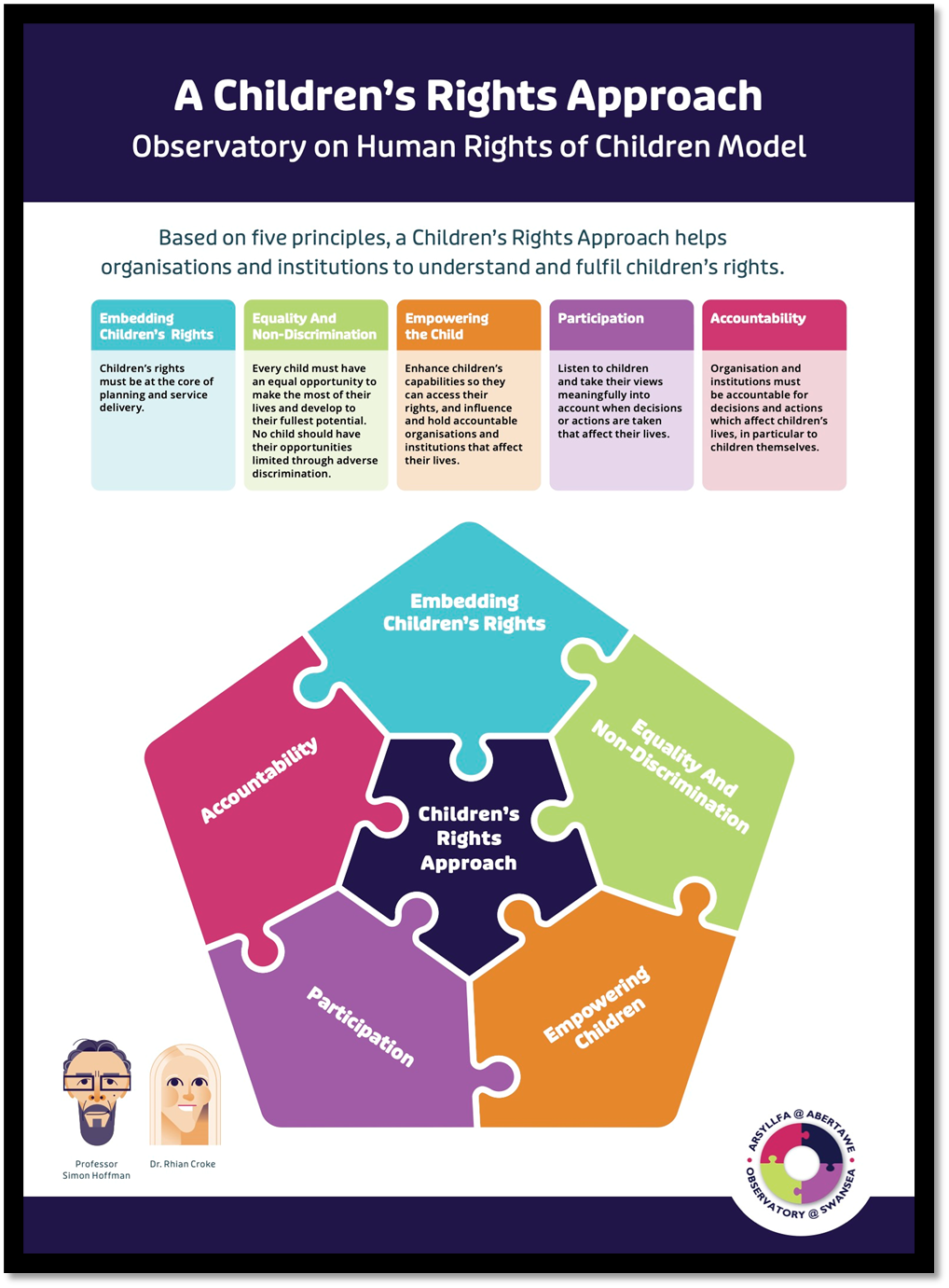
Our approach led to the determination of five principles of a CRA, accompanied by numerous examples of how these might be given effect in practice. The five CRA principles we identified are:
- Embedding children’s rights.
- Equality and non-discrimination.
- Empowering children.
- Participation of children.
- Accountability to children.
We have produced an ‘at a glance’ guide to the five principles, which is the diagram you’ll find immediately below:
If you want more detail on the CRA in Wales, with a bit more on how the principles were developed, you can read an article we wrote in 2023.
The Children’s Commissioner took our five principles, and our practice examples to develop a guide on a CRA in Wales. This was published in 2016 and is known as ‘The Right Way’.
The Children’s Commissioner has added to the Right Way guidance by specific guidance on a CRA in education, as well as in social care. And has continued to gather case studies to illustrate how the CRA principles are being applied in practice. You will find lots of information on the Right Way guides and other resources and case studies.
The Children’s Commissioner is a statutory commissioner and has a leading role in promoting children’s rights in Wales, and in holding public authorities and others to account for compliance with the UNCRC. The Children’s Commissioner’s leadership is significant and has been pivotal to many public authorities, including the Welsh Government, adopting a CRA.
In 2022, the Children’s Commissioner carried out an evaluation of the CRA based on its accumulated bank of practice examples, survey data and interviews with professionals who are adopting the guidance. Amongst a number of interesting findings, the evaluation found that in a complex operational environment the CRA has:
‘the potential to provide a consistent and common approach to rights’
and for participants it was seen as providing a:
‘framework for measuring rights-based practice and putting action to the pledges and promises that are made with good intention’.
You can access ‘The Right Way’ evaluation.
Adoption of a CRA in Wales
As we’ve mentioned, the Welsh Government has adopted the CRA principles. This was apparent in 2021 when the Welsh Government revised its Children’s Scheme. The Children’s Scheme makes arrangements for compliance with the obligation on Welsh Ministers to have due regard to the UNCRC in the exercise of their functions (the ‘due regard’ duty under the Rights of Children and Young Persons (Wales) Measure 2011). The Welsh Deputy Minister for Social Services (with responsibility for children) commented in the foreword to the revised Children’s Scheme that adopting the CRA:
‘provides a strategic framework to integrate children’s rights into every aspect of decision-making’.
The Welsh Government has also adopted the CRA principles to report on how the due regard duty is being met in a report in 2018. When the report was published the (then) Welsh Minister for Children and Social Care commented that he had found it:
‘helpful to look at our work under [the CRA principles], and we will continue to review our work in these terms to ensure that we are giving proper consideration to children’s rights in what we do.’
Influence beyond children’s rights
Our work to develop a CRA for Wales began with a focus on general human rights principles. These principles are equally relevant as the basis of human rights practice in the field of children’s rights, or any other specific areas of human rights practice areas (e.g. women’s rights, disability rights, rights of minoritised communities). They are also relevant as a guiding framework for public authorities that want to adopt a ‘Human Rights Approach’ across all services.
Interestingly one local authority in Wales has taken the CRA and has used the principles to introduce a Human Rights Approach to guide the work of statutory bodies involved in localised well-being planning and delivery.
The City and County of Swansea has declared its status as a ‘Human Rights City’ and, together with statutory partners such as the police, health board and fire service, has adopted a Human Rights Approach to public services planning and delivery (ii)
You can access their guide and a video about the guide.
Key to this initiative is to make the principles relevant to different areas of public services activity. So, the City and County of Swansea guide gives examples of how each of the five principles have been applied to promote human rights in practice by different organisations exercising different functions. This is entirely consistent with our initial idea, that a principled approach to human rights should be enriched by making strong connections to practice through case studies.
A CRA: Not just for Wales
Moving further afield, in 2020, the Jersey Children’s Commissioner commissioned us to develop children’s rights guidance for public authorities and other organisations in the States of Jersey. This guidance, Making Rights a Reality, applies the CRA principles developed for Wales and has been published by the Jersey Commissioner as a:
‘principled framework for anyone working with children, grounded in the [CRC] to help public bodies integrate children’s rights into every aspect of decision-making, policy and practice’.
We are also delighted that the Scottish Government has recently announced that they will be using the five CRA principles in their own Children’s Rights Approach. You can find out more about this in the Scottish Government’s recently published guidance.
The adoption of a CRA by the Scottish Government is complemented by a Knowledge and Skills Framework for public authorities developed by JRS Knowhow Scotland, Together, Children’s Parliament.
Using the CRA as an evaluation tool
In 2021 we carried out an evaluation of the impact of emergency measures introduced in response to COVID 19 on children’s rights in European States covered by the European Network of Ombudspersons for Children (ENOC). The research used the CRA principles as the basis for collating evidence, analysing impact, presenting the research findings and arranging recommendations. The CRA was subsequently adopted by ENOC to structure its position statement on COVID 19 emergency measures adopted by ENOC member States, and ENOC’s recommendations to protect children’s rights in future pandemics. This led to ENOC calling on the UN Secretary General Antonio Guterres to adopt the five principles of a CRA as part of mainstreaming children’s rights in the UN system.
Some reflections
We are confident that our CRA addresses the concern raised by Tobin (see start of this blog), that a Children’s Rights Approach needs to be grounded in human rights principles. The five principles are firmly rooted in international human rights. We are also confident that the five principles reflect the reality of good children’s rights practice, something which is demonstrated by the number of case studies which have now been ‘banked’ by the Children’s Commissioner. Our experience of the CRA in Wales so far has been that it can be a great help to public authorities and other organisations that are committed to better implementation of children’s rights. We are also pleased that because the CRA we developed for Wales as a ‘way of working’ with children’s rights is based on general human rights principles it is readily transferable to other jurisdictions where there is a commitment to respect, protect and fulfil human rights, as well as other human rights contexts (e.g. as a general Human Rights Approach), and is adaptable to other purposes – such as evaluation (our experience with ENOC).
Endnotes
This blog has drawn heavily on our journal article:
Rhian Croke and Simon Hoffman (2022) A response to decentralised governance of human rights: a Children’s Rights Approach in Wales, The International Journal of Human Rights.
i) John Tobin, ‘Understanding a Human Rights Based Approach to Matters Involving Children: Conceptual Foundations and Strategic Considerations’, in The Human Rights of Children: From Visions to Implementation, A. Invernizzi and J. Williams (eds), 62–98, Routeldge.
ii) With support from Professor Simon Hoffman.
 Together (Scottish Alliance for Children's Rights)