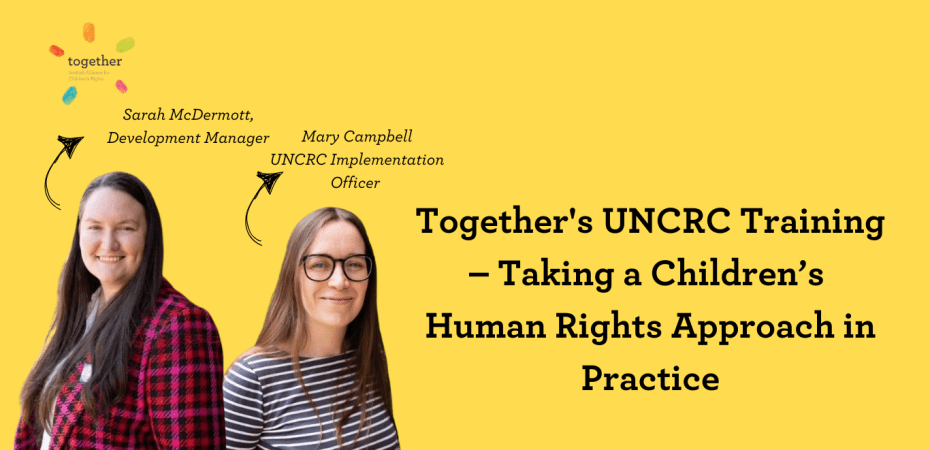
Written by Sarah McDermott and Mary Campbell
Together (Scottish Alliance for Children’s Rights) recently announced an online interactive workshop that will support individuals and organisations to develop an understanding of the UNCRC and how to implement the five principles of a children’s human rights approach in organisations and work.
Our first workshop took place on Wednesday 19th March 2025, 14:00 – 16:30, £55 for NGO members and £85 for non-members. We have additional information about the training for organisations and individuals.
We have just announced new dates for the workshop on Tuesday 17th June 2025, 10:00 – noon, and Tuesday 19th August 2025, 13:00 – 15:30 which are both online.
To sign-up to our training, organisations or individuals must register. If you require an invoice as a method of payment please email info@togetherscotland.org.uk and we can discuss further.
We asked Sarah and Mary, who will be leading the online interactive workshop, a couple of key questions around the importance of taking a Children’s Human Rights Approach and why it is crucial to ensure that children’s rights are implemented in practice.
Q1. Tell us a bit about yourself, your role within Together.
Mary Campbell, Together’s UNCRC Implementation Officer – Before coming to Together I mainly worked in the public sector, in libraries and primary schools, and as an Edinburgh City Councillor, leading on Education, Children and Families Committee for my group. At Together I have been working on the Skills and Knowledge Framework, hearing from workers all across Scotland about what is being done to realise children’s rights in the third sector and public authorities. My role within Together allows me to combine my passions and knowledge, as I work to support others understand how their practice links to children’s rights, and how to further develop their work by using a Children’s Human Rights Approach.
Sarah McDermott, Together’s Development Manager – I have worked in children’s rights for a number of years in a range of NGOs as well as both the Children and Young People’s Commissioner Scotland and the Children’s Commissioner for Jersey. My educational background is in law, and I have always been interested in exploring how people understand and experience rights. I have been the Development Manager at Together for 3.5 years, and over that time have worked with a wide variety of Together members and stakeholders exploring what children’s human rights look like in practice, learning from our diverse network and importantly from the experiences of babies, children and young people.
Q2. What is a Children’s Human Rights Approach?
A Children’s Human Rights Approach is really about how to put children’s human rights into practice. We often hear from people that while they understand children’s rights, sometimes they can feel a bit intangible in terms of what these look and feel like in practice. A Children’s Human Rights Approach offers a practical way to implement children’s human rights in your work.
Q3. Why would organisations or individuals benefit from understanding a Children’s Human Rights Approach to their work?
A deep understanding of the Children’s Human Right Approach will benefit organisations and individuals, as it provides a practical lens through which you can apply children’s rights to your work. In the training, we will detail practical steps that can be taken for each principle, and how they work together to support children’s rights in any field of work.
Q4. In the announcement, you mentioned the “five principles” and implementing them in practice, are you able to provide a sneak peek to what that is?
A Children’s Human Rights Approach is a set of five principles to help consider how your work can support children’s rights.
- Embedding – Putting children’s rights at the core of decision making, working practice, planning, reporting, and the delivery of services that affect children and young people.
- Equality and non-discrimination – Ensuring that every child and young person has what they need so that they have equal opportunity to fulfil their potential.
- Empowerment – Building the agency and capacity of children and young people as rights-holders to claim their rights.
- Participation – Listening to children and young people and taking their views seriously, as covered by article 12 of the UNCRC.
- Accountability – Delivering a proactive culture of everyday responsibility for children’s rights across services, including in decision making. Taking steps to monitor children’s rights standards and provide remedies where there is failure to meet these standards.
Q5. In your opinion, what types of organisations or individuals would benefit from undertaking this training?
We strongly believe that everyone can benefit from this training, as everyone’s work will impact on children’s rights in some way. You don’t need to be an organisation that works directly with children to think about children’s rights, as children’s rights are affected by all sorts of organisations. The focus of this training does mean that organisations and individuals already actively looking to enhance their children’s rights in practice will benefit, as that will be the focus of the session.
Ends
Sign-Up and Become a Member (Individual, Supporter or Organisations)
- Would you like to find out further information about joining Together’s membership?
Donate To Us Today!
Donate to Together and help us to promote children’s rights in Scotland and improve the lives of all babies, children and young people.
 Together (Scottish Alliance for Children's Rights)